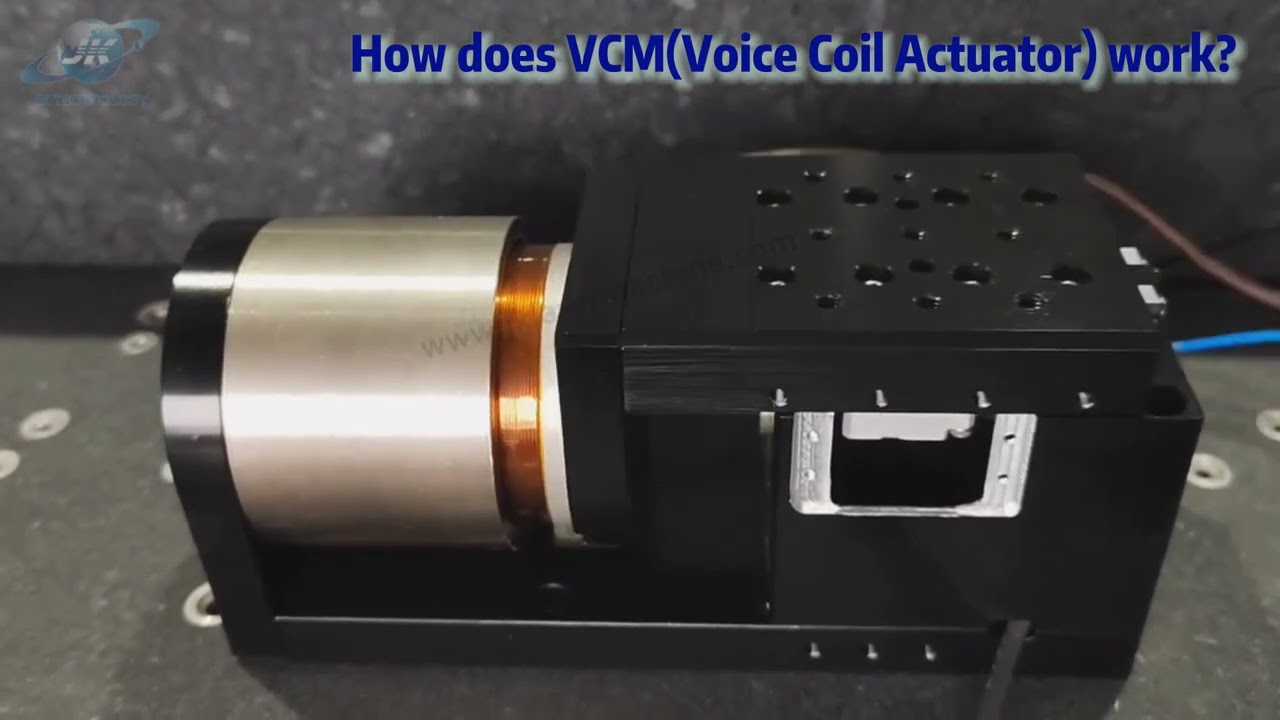
Voice Coil Linear Actuator: Overview of Structure and Operating Principle
Voice coil linear actuators are precision motion devices designed to generate controlled linear movement using electromagnetic force. They are widely used in applications that require fast response, smooth motion, and extremely accurate positioning. Unlike traditional mechanical systems that rely on gears or lead screws, these actuators operate through direct electromagnetic interaction, making them highly efficient and reliable.
In modern motion systems, a voice coil linear actuator is often preferred for its simple construction and high-performance output. By converting electrical energy directly into linear force, it eliminates mechanical transmission losses and reduces wear over time. This direct-drive approach allows for precise motion control, making it suitable for demanding industrial and scientific applications.
Structure of a Voice Coil Linear Actuator
The structure of a voice coil linear actuator is relatively simple compared to other motion systems, yet it is carefully engineered for high precision and stability. It typically consists of a few key components that work together to produce linear motion.
The main structural elements include:
- Coil assembly: A copper-wound coil that carries current and generates electromagnetic force
- Permanent magnet system: Provides a stable magnetic field for interaction with the coil
- Moving armature or shaft: Converts electromagnetic force into linear displacement
- Housing frame: Ensures alignment and structural support
- Guidance mechanism: Maintains smooth, friction-free linear motion
This compact structure allows for lightweight design and high responsiveness, making it suitable for both miniature and industrial-scale applications.
Operating Principle of Voice Coil Linear Actuators
The operating principle of a voice coil linear actuator is based on the Lorentz force law. When an electric current flows through a coil placed within a magnetic field, a force is generated perpendicular to both the current direction and magnetic field.
This force drives the coil or magnet assembly in a linear direction. The magnitude of motion depends on the strength of the current and the magnetic field intensity, allowing for highly precise and controllable movement.
Because the system responds instantly to changes in current, it enables smooth acceleration and deceleration without mechanical delay.
Key Characteristics of Operation
Voice coil linear actuators are known for their unique performance characteristics, which make them suitable for precision applications:
- Direct-drive motion: Eliminates mechanical transmission components
- Linear force control: Output force is proportional to input current
- Fast response time: Nearly instantaneous reaction to control signals
- High positioning accuracy: Suitable for micron-level adjustments
- Low mechanical wear: Minimal friction due to non-contact operation
These features make them ideal for systems that require consistent and repeatable motion performance.
Role of Magnetic Field Design
The performance of a voice coil linear actuator depends heavily on the design of its magnetic circuit. A well-designed magnetic field ensures stable force generation and efficient energy conversion.
Important factors include:
- Uniform magnetic flux distribution
- High-strength rare-earth magnets such as neodymium
- Optimized air gap for consistent force output
- Thermal stability under continuous operation
A strong and stable magnetic field allows the actuator to maintain consistent performance across its full stroke range.
Applications of Voice Coil Linear Actuators
Due to their precision and responsiveness, voice coil linear actuators are used in a wide range of industries, including:
- Semiconductor wafer positioning systems
- Optical focusing and imaging equipment
- Medical devices requiring controlled linear motion
- Precision testing and measurement systems
- Robotics and micro-positioning applications
These applications rely on the actuator’s ability to deliver accurate and repeatable motion without mechanical backlash.
Conclusion
Voice coil linear actuators combine a simple structure with advanced electromagnetic operating principles to deliver highly precise linear motion. Their direct-drive design, fast response, and excellent controllability make them essential in modern precision engineering systems. As industries continue to demand higher accuracy and efficiency, these actuators will remain a key technology in advanced motion control applications.